
Criminal Court Records in Carroll County
A criminal court record is the official file a court keeps for one criminal case. It starts when a charge is filed. It then grows with every hearing, motion, and order. In Carroll County, the Circuit Clerk preserves felony case files for the Circuit Court. The clerk logs each filing, indexes the parties, and holds the indictment, plea entries, verdict, and sentencing order. Once a case closes, the file stays a public record. Court staff cannot give legal advice. They can confirm a case number, a filing date, or a disposition for a member of the public.
Carroll County sits in the 5th Circuit Court District. That district covers Attala, Choctaw, Grenada, Montgomery, Webster, Winston, and Carroll. Felony prosecutions, indictments, and jury trials belong to the Circuit Court. Many cases begin lower, though. Justice Court often handles the initial appearance, the first bond decision, and the preliminary hearing before a felony heads to a grand jury. Municipal Court handles city misdemeanors and ordinance cases. Lower-court convictions, citations, and minor matters stay in those courts, while serious charges move up to a Circuit Court file. A closer look at the charging documents themselves lives in the Carroll County arrest records and court charges.
How to Search Carroll County Criminal Court Records
There is no county-only court search for Carroll County. Felony case files run through Mississippi Electronic Courts, the statewide system known as MEC. Public users reach it through PAMEC, the public access side. Circuit cases use the Fifth Circuit MEC login, and the Fifth Circuit court info page lists case flags and status terms. Carroll County Circuit Court went paperless in MEC on June 22, 2020, so newer felony files are electronic.
- Register for a public account at the PAMEC registration page. The account costs $10 per year, and document views are billed by the page.
- Log into the Fifth Circuit MEC site and search by defendant name or by case number.
- Narrow the results by court district, case type, and filing date to find the right felony file.
- Open the case to read the docket entries, the charges, the plea, and the disposition.
- Request a certified copy from the Circuit Clerk if a court or agency needs an official version.
Older felony files may not be digitized. Sealed and expunged cases will not appear in an ordinary public search. When a record is missing, call the Circuit Clerk in Carrollton at 662-237-9274 or in Vaiden at 662-464-5476 and ask which district holds the file. For a statewide criminal history rather than a single case, the Mississippi Department of Public Safety runs the Criminal Information Center, which handles record checks and the sex offender registry.
The bench that hears Carroll County felony cases is part of the Fifth Circuit, and the Mississippi Judiciary news archive records judges taking the oath for that court.
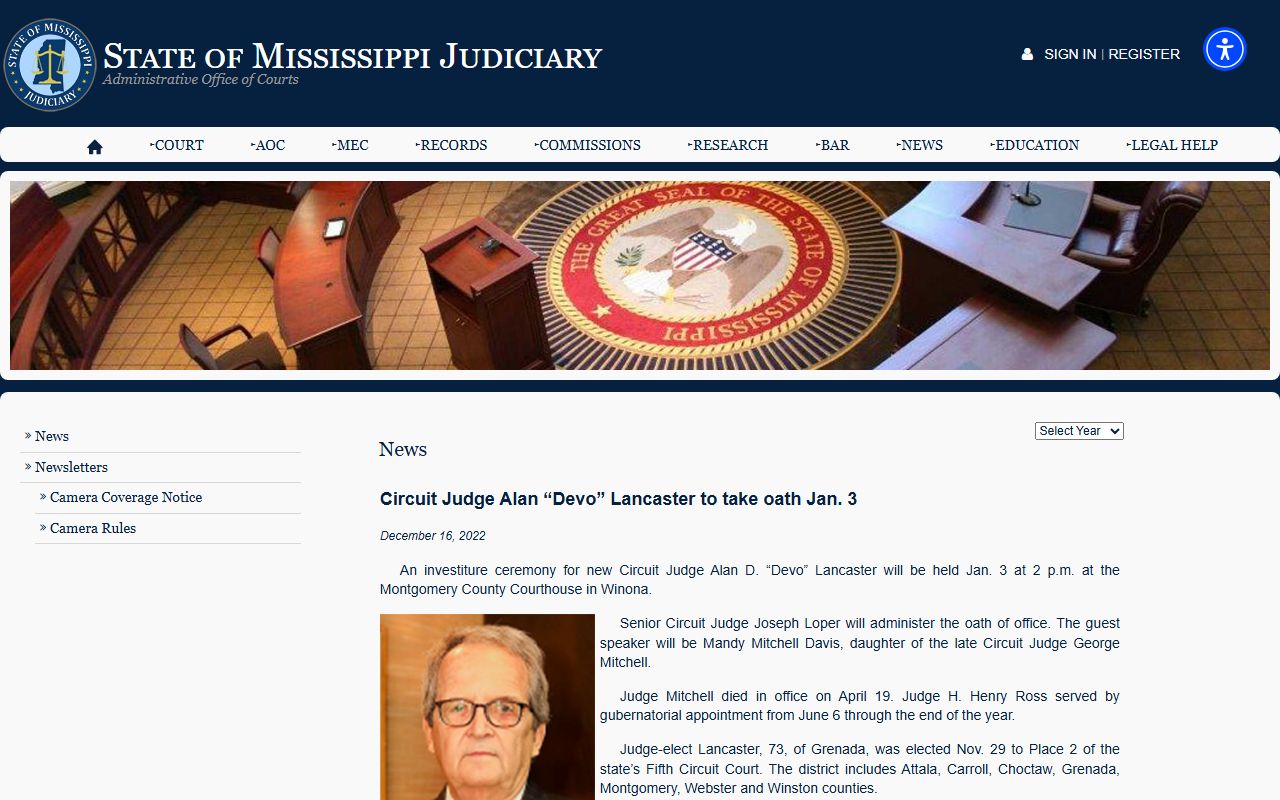
The same Fifth Circuit judges sign the orders, verdicts, and sentences that fill a Carroll County criminal court record. Knowing the court behind a case helps a searcher confirm a result and request the right certified document.
Note: Justice Court and Municipal Court records are not on MEC, so traffic, misdemeanor, and early-stage matters must be checked by phone or in person.
Stages of a Carroll County Criminal Case
A felony case moves through fixed steps, and each step leaves a mark in the file. The path often starts in Justice Court with an arrest, an initial appearance, and a bond setting. A preliminary hearing may follow. If the case proceeds, a grand jury can return an indictment that sends the matter to the Circuit Court. From there the docket fills with arraignment, motions, hearings, and a final outcome. Reading those entries in order tells the story of the case.
Case flow: Charges Filed › Arraignment › Pretrial / Motions › Plea or Trial › Disposition › Sentencing
| Stage | What Happens |
|---|---|
| Charges Filed | An affidavit, a citation, or a grand jury indictment formally opens the case and lists each charge. |
| Arraignment | The defendant hears the charges in open court and enters a first plea, often guilty, not guilty, or no contest. |
| Pretrial / Motions | Lawyers file motions, exchange evidence, argue bond, and may negotiate a plea. Orders and hearing dates are logged. |
| Plea or Trial | The case ends with a plea or goes to a judge or jury trial that produces a verdict. |
| Disposition | The court records the result for each charge, such as guilty, dismissed, or nolle prosequi. |
| Sentencing | After a conviction the judge imposes prison, probation, fines, costs, or restitution, and the order joins the file. |
What a Carroll County Criminal Court Record Shows
A Circuit Court criminal file holds a defined set of fields. MEC and PAMEC display the public ones once a search opens the case. The record names the court and district, the parties, and the charges. It carries plea entries, status flags, docket events, and the final disposition. Financial fields track fines, costs, bonds, and restitution. Some fields stay restricted, and sealed or expunged cases may show only a flag with no detail.
| Field | What It Shows |
|---|---|
| Court and District | Fifth Circuit Court District, and whether the case sits in the First District at Carrollton or the Second District at Vaiden. |
| Case Number | The unique number the clerk assigns to track every filing in the case. |
| Defendant and Parties | The accused person, the prosecuting authority, and attorneys of record where public. |
| Charges | Each count, often from an indictment, with the offense charged and any later amendments. |
| Status Flags | Public flags such as Arraignment Pending, Plea Pending, Trial Pending, Capias Pending, Sealed Case, Expunged, or Case Closed. |
| Docket Entries | Motions, orders, hearings, arraignment, plea, trial, warrant returns, and probation filings in date order. |
| Plea | The defendant's response to each charge, such as guilty, not guilty, or nolo contendere. |
| Disposition | The final outcome of each charge, including dismissals and nolle prosequi entries. |
| Sentence | Punishment after a conviction, such as prison, probation, post-release supervision, fines, costs, or restitution. |
A full breakdown of every court record type, civil and criminal, sits with the Carroll County court records overview.
Note: A case number, an exact name spelling, and a filing district make a clerk request far quicker than a partial name alone.
Charges vs. Convictions
Being charged is not the same as being convicted. A charge is an accusation. A conviction is a finding of guilt by plea or verdict. A Carroll County criminal court record can show charges that were later dropped, dismissed, reduced, or that ended in an acquittal. Reading only the charge can give a false picture. The disposition line tells the real outcome.
| Charge | Conviction | |
|---|---|---|
| Stage | Accusation at the start of a case | Verdict or guilty plea at the end |
| Burden of Proof | Probable cause | Beyond a reasonable doubt |
| Can Change | Amended, reduced, or dropped | Stands unless appealed or expunged |
| Public Record | Yes | Yes |
Reading Dispositions and Sentences
A disposition is the outcome a court records for each charge. Common entries are guilty, not guilty, and dismissed. A nolle prosequi entry means the prosecutor dropped the charge. A nolo contendere, or no-contest, plea counts like a guilty plea for sentencing but is not a direct admission. Some matters end in a deferred result tied to a program. Each result is logged in plain terms in the file.
A sentence follows a conviction. Felony sentences in the Circuit Court can include prison time with the Mississippi Department of Corrections, probation, post-release supervision, fines, court costs, and restitution. The record may carry flags like Probation, Probation Violation Pending, or PRS Violation Pending. Reading the sentence means matching each charge to its outcome and to any supervision terms. A long docket can list several charges with different results, so check every line and not just the lead charge.
- Disposition
- The final result a court records for a charge or a whole case.
- Nolle prosequi
- The prosecutor's decision not to proceed on a charge.
- Capias
- A writ that directs an officer to take a person into custody.
- Bench warrant
- A warrant a judge issues, often after a missed court date, and it can appear as a docket flag.
- Post-release supervision
- Court-ordered monitoring that follows a prison term, abbreviated PRS in the record.
Prosecution and Defense in Carroll County
Two offices can prosecute a Carroll County criminal matter. Felony cases in the Fifth Circuit are handled by District Attorney Adam Hopper, whose office can be reached at 662-226-8545 and serves all seven counties in the district. County-level prosecution runs through County Prosecuting Attorney Lori Bell, P.O. Box 167, Carrollton, MS 38917, phone 662-237-9228. The arresting agency and the sheriff record the booking facts, but the prosecutor decides which charges to file and pursue. That decision drives much of what a criminal court record later shows.
The defense side appears in the file too. A defendant may hire a lawyer or, when eligible, receive appointed counsel. The court appoints counsel for indigent defendants after a screening. The Mississippi Office of State Public Defender maintains the felony defender directory that lists the Carroll County contact, attorney Rusty Harlow of Grenada, phone 662-226-7215. Appointment depends on the court, the case type, and a finding of need, so a defender is assigned through the case rather than hired off the list.
Fifth Circuit Intervention Court
Some Carroll County defendants enter intervention court instead of a standard prosecution. The Mississippi Judiciary runs intervention courts as special programs that supervise drug-using offenders through testing, treatment, and a mix of sanctions and incentives. Carroll County falls in the Fifth Circuit District program, which covers the same seven counties as the felony court. Eligibility is case-specific and usually depends on a prosecutor recommendation, a screening, and court approval.
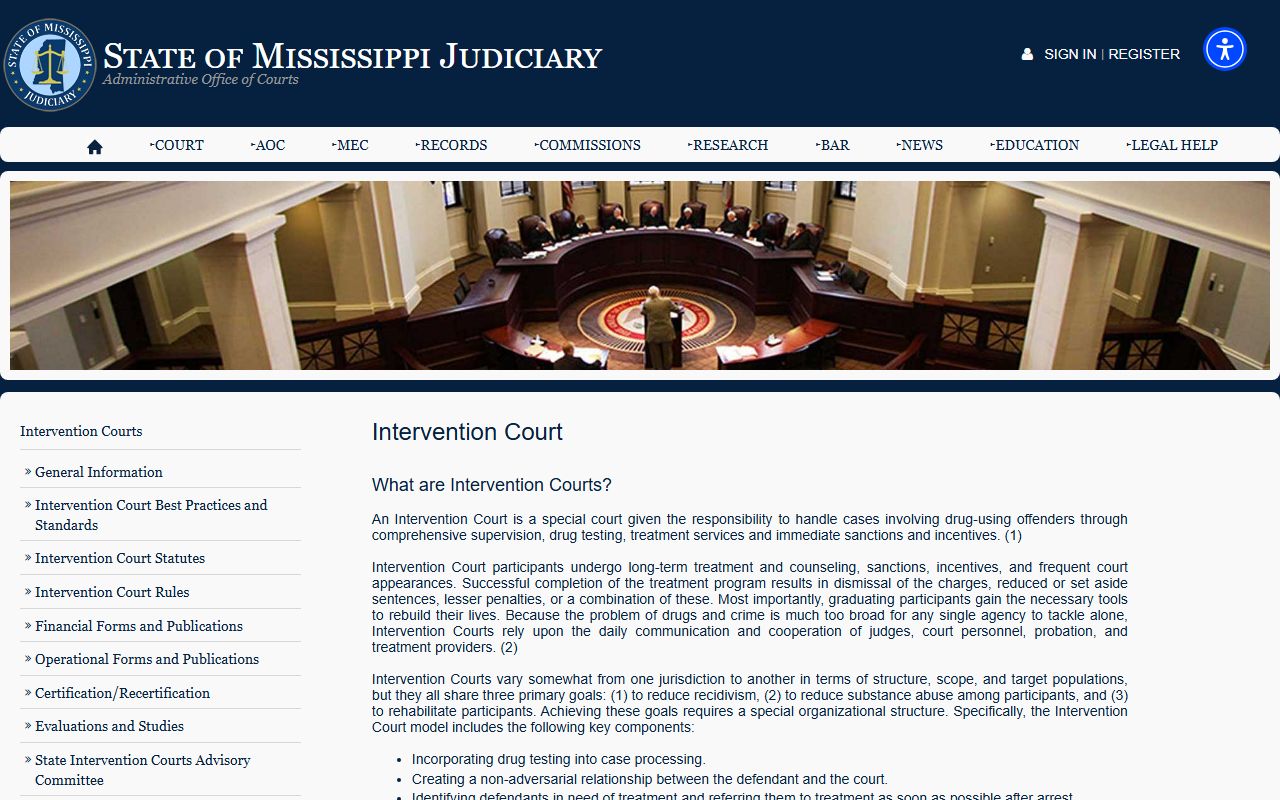
The program changes how a case reads in the record. A charge can stay visible as a pending criminal matter while a participant is enrolled, often under a Pretrial Interv Pending flag. Completion can affect the disposition, the sentence, supervision, or later expunction eligibility. The drug court for the Fifth Circuit completed statewide coverage of Mississippi drug courts, a milestone the Mississippi Judiciary news archive documents.
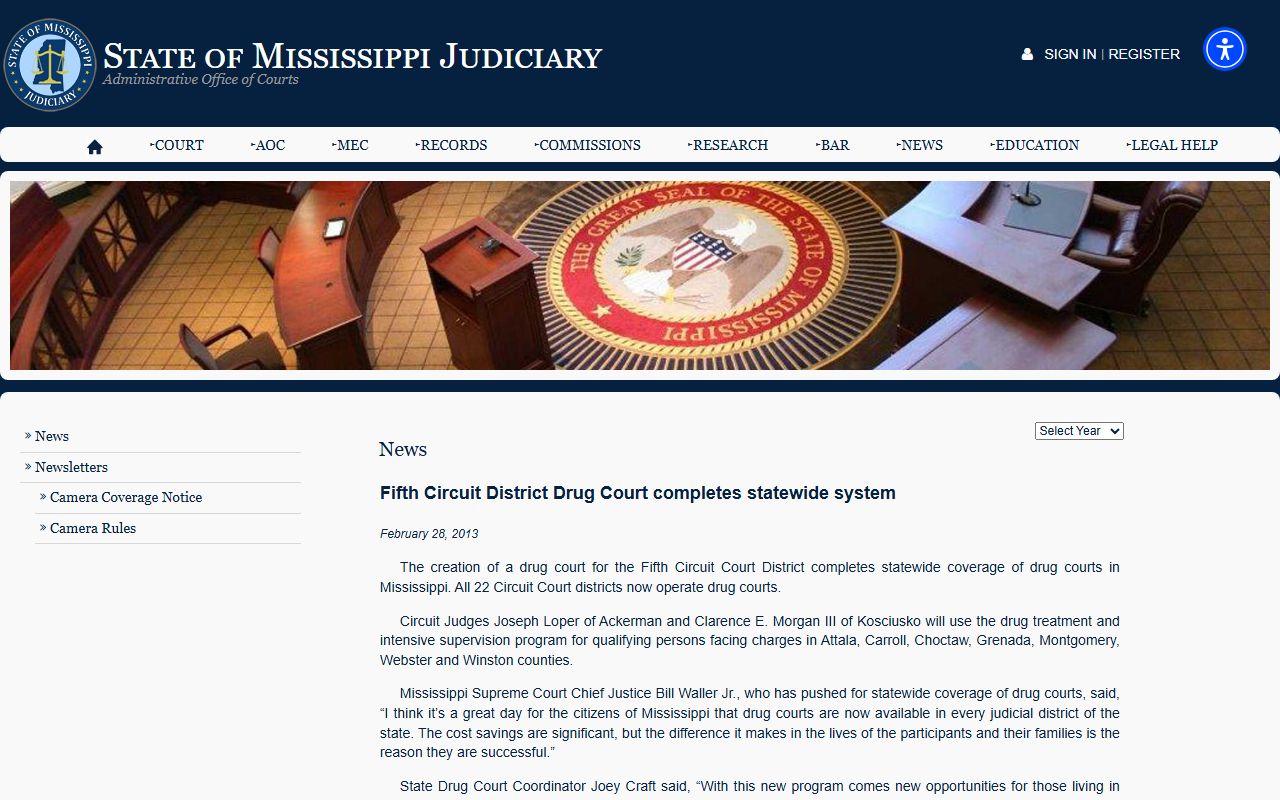
For a Carroll County felony, the intervention-court track and its flags can explain why a file looks open for a long time before a final disposition appears.
Note: Local program details for Carroll County, such as the current coordinator and meeting schedule, are set case by case, so ask the Circuit Clerk or the prosecutor about eligibility.
Sealed vs. Expunged Records
Sealing and expunction both limit public access, but they are not the same. A sealed case is closed from public view by statute or court order, while an expunged record is removed and treated as if it never existed. Mississippi Code Section 99-19-71 governs many expunction petitions. It allows expunction of certain misdemeanor convictions and one qualifying felony after conditions are met, including paid fines and waiting periods. Some felonies are excluded. The petition is usually filed in the court where the charge or conviction occurred.
| Sealed | Expunged | |
|---|---|---|
| Visibility | Hidden from public view | Removed and treated as never existed |
| Law Enforcement | Limited access remains | Very limited access |
| MEC Flag | Sealed Case | Expunged |
| Eligibility | Set by statute or court order; access for a party or attorney | Certain misdemeanors and one qualifying felony under Section 99-19-71 |
An expunction reaches more than the court file. A person clearing a record should verify every linked source, including the sheriff arrest record, any Justice or Municipal Court file, the Circuit Court case, the prosecutor record, and state criminal-history systems. After an order is entered, public search results may show no record or only a flag, but agency processing can take time.
Public Access to Carroll County Criminal Records
Criminal case files are public records in Mississippi unless a law makes them confidential. The Mississippi Public Records Act supports inspection of records held by government offices. Court files still carry their own limits for sealing, expunction, youth confidentiality, and protected documents. Remote access runs through a PAMEC account, and some documents stay restricted to attorneys of record. A requester should start with the office that holds the record, which for felony cases is the Circuit Court or the Circuit Clerk.
Key Statutes:
Mississippi Code Title 25, Chapter 61 - the Public Records Act makes government records open for inspection unless a statute exempts them.
Mississippi Code § 43-21-251 - youth court records stay confidential except as the youth-court law allows.
Background Check Considerations
A casual case lookup and a formal background check are not the same. Reading a single MEC file answers a personal question about one case. A hiring, housing, or licensing decision falls under the federal Fair Credit Reporting Act and must use a regulated provider. Mississippi also runs a statewide channel for criminal history through the Department of Public Safety Criminal Information Center. For most legal uses, a certified copy from the Circuit Clerk carries the weight that a screenshot does not.
Important: This site is not a consumer reporting agency under the FCRA, and its records may not be used for credit, employment, tenant, insurance, or similar decisions.
Restricted Carroll County Criminal Records
Not every criminal matter is open to a public search. Some files are confidential by law, and others are limited by a court order. A search may return only a flag, a sealed label, or no result at all. Knowing which categories stay closed saves a wasted trip to the clerk's counter.
- Youth and juvenile cases held by the youth court, confidential under Title 43, Chapter 21.
- Sealed cases that show a Sealed Case flag but no public detail.
- Expunged cases removed from ordinary search results.
- Redacted identifiers such as Social Security numbers, dates of birth, and minor children's names.
- Documents limited to attorneys of record in a pending matter.
For anything a public search cannot reach, the Circuit Clerk is the right first call. The clerk can confirm whether a file exists, whether it is sealed, and which Carroll County district holds it. A juvenile or expunged matter will stay closed without proper authorization or a court order.